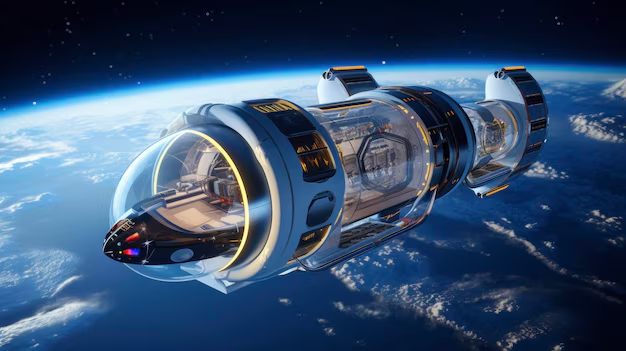
The boundaries of human travel are expanding beyond our atmosphere. What was once the exclusive domain of state-sponsored astronauts and rigorous government programs has evolved into the next frontier for commercial adventure. Orbital space tourism is transitioning from an ultra-exclusive luxury into a structured, highly sophisticated industry. As aerospace technology advances, the dream of living, working, and vacationing in Low Earth Orbit (LEO) is fast becoming a reality.
This comprehensive analysis explores the rapid technological evolution, emerging destinations, regulatory environments, and socioeconomic impacts that define the future of commercial orbital space travel.
1. Defining the Orbital Tourism Landscape
To understand the trajectory of this industry, it is essential to distinguish orbital tourism from its suborbital counterpart. While suborbital flights offer a brief, minutes-long touch point with microgravity at the edge of space, orbital missions require vehicles to achieve cosmic velocity to remain in a stable path around the planet.
   Suborbital Flight                  Orbital Flight
+-----------------------+        +-----------------------+
| Speed: ~Mach 3 - 4    |        | Speed: ~Mach 25       |
| Altitude: ~100 km     |   vs   | Altitude: 300 - 400+ km|
| Duration: Minutes     |        | Duration: Days/Weeks  |
| Experience: Brief     |        | Experience: Extended  |
+-----------------------+        +-----------------------+
The engineering precision required for orbital flight introduces unique challenges and opportunities for the commercial market:
A. Velocity Thresholds: Reaching orbit demands accelerating a spacecraft to approximately 28,000 kilometers per hour (17,500 miles per hour). This speed generates enough centrifugal force to balance the gravitational pull of our planet.
B. Thermal Management: Returning from orbit subjects the spacecraft to extreme frictional heat. Thermal protection systems must withstand temperatures exceeding 1,600 degrees Celsius during atmospheric re-entry.
C. Life Support Systems: Unlike short suborbital trips, orbital missions last for days or weeks. This necessitates robust closed-loop Environmental Control and Life Support Systems (ECLSS) to manage oxygen generation, carbon dioxide scrubbing, and water recycling.
2. Technological Drivers Accelerating Commercial Access
The shift toward sustainable commercial space flight is propelled by breakthroughs in rocket reusable design and material science. For decades, the high cost of expendable launch vehicles limited space access to superpower governments. Today, private enterprises are rewriting the economic rules of the cosmos.
Reusable Launch Architecture
The widespread adoption of vertical landing booster stages has fundamentally changed the financial landscape of space flight. The fuel for a rocket launch accounts for less than 1% of the total cost; the structural hardware represents the remaining 99%. By recovering, refurbishing, and reflating massive booster cores, launch providers have slashed the price per kilogram to orbit.
Advanced Automation and Avionics
Modern commercial orbital capsules utilize autonomous docking, navigation, and emergency abort systems. Passengers no longer need to be skilled jet pilots or master complex mechanical systems. Touchscreen interfaces and AI-driven telemetry handle normal operations, allowing civilian travelers to focus entirely on their orbital experience while ground control centers monitor health parameters remotely.
3. Commercial Destinations in Low Earth Orbit
The International Space Station (ISS) has long served as the primary destination for private astronauts. However, as the ISS nears its planned retirement, a new generation of commercial platforms is rising to accommodate the orbital hospitality sector.
Modular Private Space Stations
Private aerospace corporations are actively constructing independent commercial outposts. These structures feature expansive viewing cupolas, research laboratories, and luxury passenger quarters.
A. Axiom Space Station: Initially launching modules that attach to the ISS, this platform will eventually detach to form a free-flying commercial destination optimized for manufacturing, research, and luxury tourism.
B. Orbital Reef: Designed as a mixed-use business park in space, this infrastructure supports industrial research, media production, and space tourism alike.
C. Starlab: A continuously crewed commercial platform focused on maintaining an uninterrupted human presence in LEO while providing comfortable accommodations for private travelers.

Orbital Hospitality Innovations
Designing living quarters for microgravity introduces unprecedented interior architecture challenges. Traditional furniture becomes obsolete when there is no “up” or “down.” Future space hotels focus on soft, padded interiors, adjustable anchor tethers for sleeping, and specialized culinary suites capable of handling liquid and crumb management in zero gravity.
4. The Private Astronaut Experience
The journey of an orbital tourist begins long before the rocket engines ignite. Preparing civilians for the physical and psychological demands of space flight requires structured training programs that mirror professional astronaut preparation.
Pre-Flight Preparation and Conditioning
Private travelers undergo intensive training weeks before launch to ensure safety and operational competence. This curriculum includes:
A. Centrifuge Training: Simulating the high G-forces experienced during launch and atmospheric re-entry to prevent tunnel vision or loss of consciousness.
B. Hypobaric Chamber Exposure: Educating passengers on the signs of hypoxia (oxygen deprivation) and training them to utilize emergency oxygen systems seamlessly.
C. Microgravity Adaptation: Utilizing parabolic aircraft flights to familiarize customers with moving, eating, and orienting themselves in a weightless environment.
In-Orbit Activities and Science Integration
Modern orbital tourists are rarely passive observers. Many private missions incorporate citizen science, allowing travelers to conduct biomedical research, operate Earth-observation cameras, or test experimental manufacturing processes. This dual focus on leisure and contribution adds profound depth to the orbital travel experience.
5. Economic Horizons and Market Dynamics
The financial ecosystem supporting orbital tourism is rapidly expanding. While initially restricted to ultra-high-net-worth individuals, evolving market dynamics are paving the way for broader accessibility over the next several decades.
| Market Segment | Target Demographics | Typical Cost Structure | Mission Profiles |
| Elite Exploration | Ultra-High-Net-Worth Individuals (UHNWIs) | $30M – $60M per seat | Multi-week stays on private space stations |
| Corporate Research | Private Enterprises, Sovereign Nations | Funded via corporate R&D budgets | Short-duration missions with a payload focus |
| Franchise & Media | Entertainment Networks, Broadcasters | Sponsored productions | In-orbit filming, cultural events, live broadcasts |
As production scales and multi-passenger spacecraft like next-generation heavy-lift platforms mature, the industry expects a dramatic democratization of costs. Projections suggest that within thirty years, the cost of an orbital ticket could fall to the price range of an ultra-luxury terrestrial vacation, expanding the consumer base from hundreds of individuals to tens of thousands globally.
6. Regulatory Frameworks and Safety Standards
Operating a commercial hospitality industry in the vacuum of space requires strict regulatory oversight. Navigating international space law and passenger liability is a complex, evolving challenge for operators and governments.
International Treaties and Jurisdiction
The foundational framework for all space activities rests on the Outer Space Treaty of 1967. Under this international agreement, nations bear responsibility for national space activities, whether carried out by government agencies or non-governmental entities. This means space tourism operators must secure licenses from their respective domestic authorities, such as the Federal Aviation Administration (FAA) in the United States, which regulates commercial space transportation.
The Informed Consent Regime
Currently, regulatory frameworks for space tourism focus heavily on an “informed consent” model. Because space flight is inherently risky, governments do not certify space tourism vehicles to the same stringent safety margins as commercial airliners. Instead, operators are legally mandated to disclose all known risks of the vehicle and launch system transparently. Passengers must sign comprehensive waivers demonstrating they fully understand the potential hazards before boarding.
7. Environmental and Sustainability Challenges
The rapid increase in launch frequencies sparked by orbital tourism brings environmental responsibilities to the forefront. Balancing cosmic exploration with terrestrial environmental protection is a vital consideration for the modern aerospace industry.
Atmospheric Impact of Rocket Emissions
Different propulsion systems interact with Earth’s atmosphere in diverse ways. Rocket engines burning kerosene-based fuels release black carbon (soot) into the stratosphere, which can influence solar radiation retention. To combat this, the industry is increasingly transitioning toward cleaner fuel alternatives:
A. Liquid Methane and Oxygen: This combination burns cleanly, producing significantly fewer particulate byproducts and allowing for simpler engine reuse.
B. Liquid Hydrogen and Oxygen: Producing water vapor as its primary exhaust byproduct, this propellant combination offers a highly sustainable profile when harvested using green energy infrastructure.
Orbital Debris Mitigation
As traffic in LEO intensifies, tracking and mitigating orbital debris is critical to preventing catastrophic collisions. Space tourism operators must design their architectures with end-of-life disposal strategies in mind. This includes ensuring upper rocket stages de-orbit immediately after payload deployment and constructing space stations with active debris-shielding technologies.
8. The Psychological Horizon: The Overview Effect
Beyond the technical achievements and financial metrics, orbital tourism offers a profound cognitive shift known as the Overview Effect. Coined by space philosophers, this phenomenon describes the transformative experience reported by astronauts when viewing Earth from orbit.
“From space, the planet appears as a fragile, borderless ball of life suspended in a vast void. This perspective consistently fosters a deep sense of global citizenship, an intensified commitment to environmental stewardship, and a renewed appreciation for human interconnectedness.”
By opening this experience to civilians including artists, policymakers, educators, and global leaders—orbital tourism has the potential to reshape cultural narratives on Earth. The long-term value of space travel may lie not just in what we discover out there, but in the deepened perspective we bring back home.
9. Future Trends: Beyond Earth Orbit
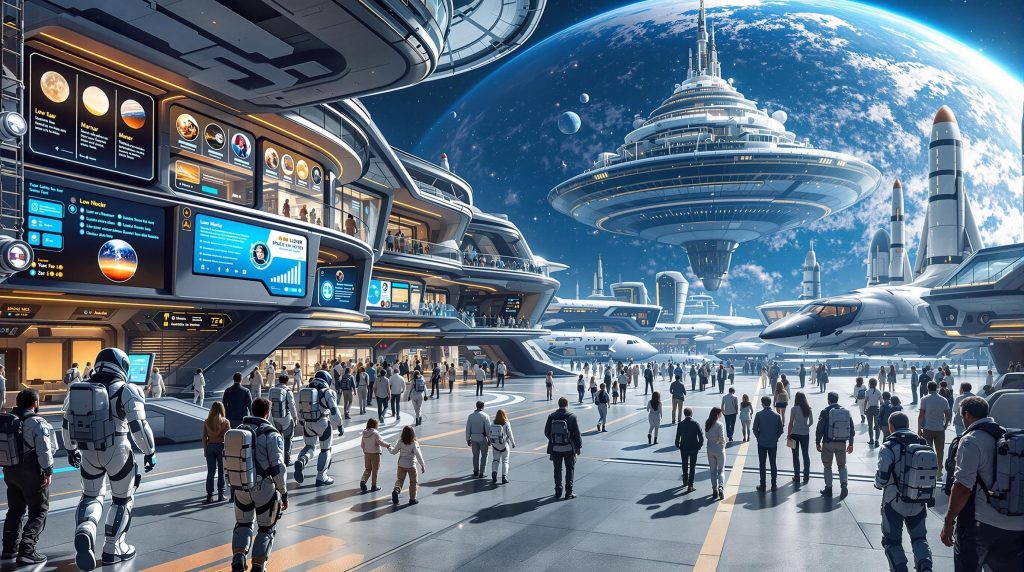
As the infrastructure in Low Earth Orbit matures, the long-term vision for space tourism naturally stretches further into the solar system. The stepping stones established in LEO are directly applicable to deeper exploration initiatives.
Low Earth Orbit (LEO) ---> Cis-Lunar Transit ---> Permanent Lunar Bases
     (Now - 2030)              (2030 - 2040)             (2040+)
The progression beyond our immediate orbital neighborhood is projected to follow a deliberate path:
A. Cis-Lunar Tourism: Private missions carrying passengers on free-return trajectories around the Moon, providing historic, close-up views of the lunar far side.
B. Lunar Orbital Habitats: Transitioning civilian travelers to sustained space stations orbiting the Moon, serving as a hub for both science and extreme exploration.
C. Surface Excursions: The eventual establishment of commercial outposts on the lunar surface, allowing private citizens to walk on the moon and explore historic landing sites.
Conclusion: The New Age of Human Exploration
The future of orbital space tourism is an evolving reality driven by technological breakthroughs, private capital investments, and a shared human desire for exploration. As reusable rockets, commercial habitats, and international regulatory frameworks solidify, the cosmos will become increasingly integrated into our economic and cultural landscapes. What begins today as an elite expedition will ultimately pave the way for a multi-planetary human future, forever changing how we view our planet and our place in the universe.