
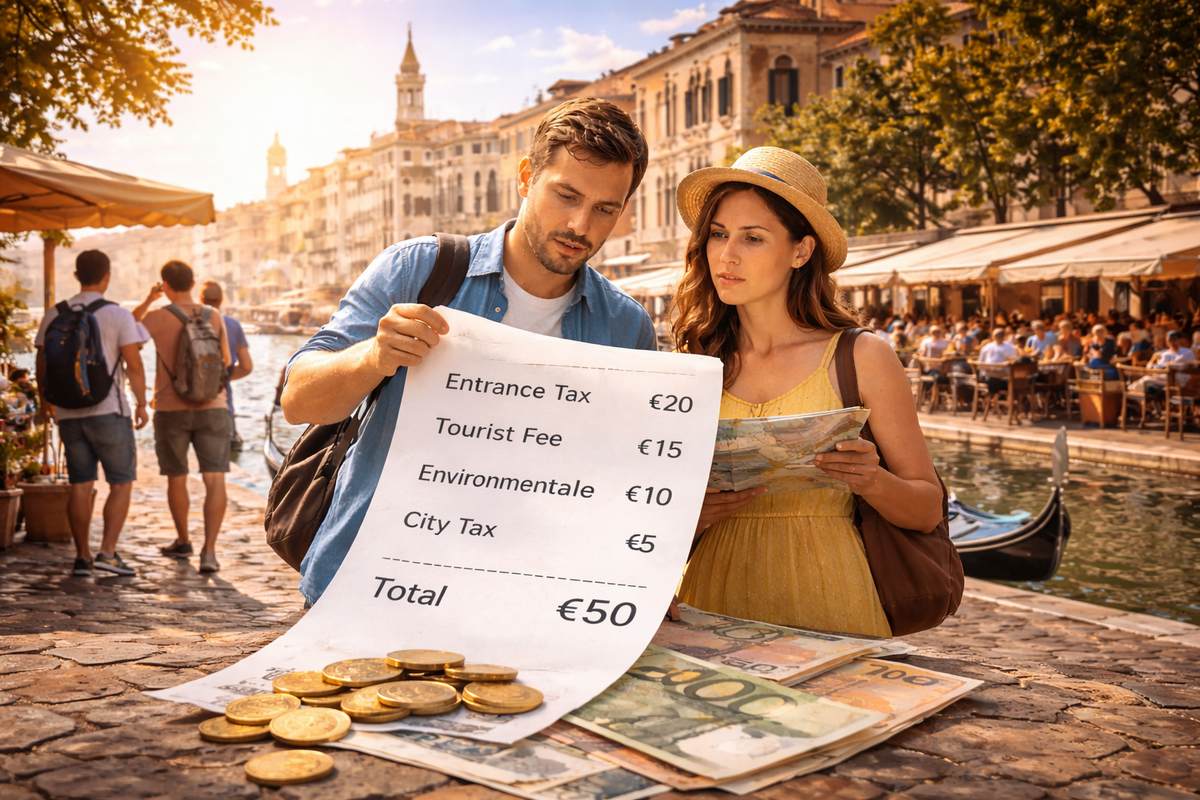
Imagine planning your dream European vacation. You spent weeks comparing flight deals, tracking down the perfect boutique hotels, and mapping out every historical landmark from Paris to Venice. You factored in meals, train tickets, and museum passes. But as you check out of your first hotel, the receptionist hands you a bill featuring an unexpected surcharge.
This is not a mistake or a sneaky hotel scam. It is a government-mandated tourist tax, and in 2026, these fees are hitting travelers harder than ever before.
Across Europe, the era of cheap, friction-free tourism is rapidly shifting. Facing intense pushback from local residents over overtourism, skyrocketing housing costs, and strained infrastructure, European municipalities are aggressively introducing or raising visitor levies. These charges are frequently left out of the initial booking prices listed on major online travel agencies, making them true hidden costs that can easily disrupt a carefully planned vacation fund.
To help you navigate this changing financial landscape, this comprehensive guide breaks down everything you need to know about European tourist taxes in 2026, how they are calculated, and how to accurately budget for your next journey across the Atlantic.
Understanding the European Tourist Tax System
The phrase “tourist tax” does not refer to a singular, uniform fee. Instead, it serves as an umbrella term for various localized financial measures designed to generate revenue from visitors. Local authorities typically justify these fees as a necessary means to fund city cleanups, maintain historical landmarks, improve public transit, and mitigate the ecological footprint left by mass tourism.
Depending on your destination, these taxes are calculated and collected through three primary frameworks:
A. The Flat Rate Per Night Model
This is the most widespread method used throughout Europe. Under this system, you are charged a fixed Euro amount per person for every night you stay in an accommodation. The exact fee is usually tied directly to the official star rating of your lodging. A budget hostel might carry a negligible charge of €1.00 per night, whereas a luxury five-star resort can demand upwards of €10.00 to €15.00 per person, per night.
B. The Percentage-Based Model
Instead of charging a fixed fee, a growing number of progressive European cities assess their tourist tax as a direct percentage of your total room rate (excluding local value-added taxes, known as VAT). This model heavily impacts luxury travelers. If you book a high-end suite, your tax bill scales upward proportionally, sometimes adding hundreds of Euros to a multi-night stay.
C. The Access and Day-Tripper Entry Fees
A newer and highly controversial development in European travel is the introduction of entry fees targeted specifically at day-trippers. These are individuals who visit a high-traffic city or landmark for a few hours without booking overnight accommodations, meaning they do not pay traditional lodging taxes but still utilize local infrastructure. These fees require pre-registration online to generate a digital entry pass.
Major European Destinations with Surging Visitor Levies
To avoid unexpected financial surprises at checkout, travelers must understand where these taxes have risen most sharply. Here is an in-depth breakdown of the current 2026 tourist tax landscapes in Europe’s most heavily visited regions.

Amsterdam, The Netherlands
Amsterdam holds the undisputed record for the highest overall tourist tax burden in Europe. The city utilizes a percentage-based calculation, setting its municipal tourist tax at 12.5% of the base room price.
However, the real financial shock for 2026 travelers stems from a major shift in national tax policy: effective January 1, 2026, the Dutch government increased the VAT on short-stay overnight accommodations from 9% to 21%.
To illustrate how this impacts your budget, let us review the mathematical breakdown for a standard hotel stay:
-
Base Room Price: €200.00 per night
-
Municipal Tourist Tax (12.5%): €25.00
-
Subtotal Before VAT: €225.00
-
New 2026 VAT (21%): €47.25
-
Total Cost Per Night: €272.25
In this scenario, you are paying a total of €72.25 in combined taxes per single night, which effectively adds a 36% premium to your base room rate. For a simple three-night stay, you must budget more than €215.00 purely for government fees. Furthermore, Amsterdam implements no maximum cap on consecutive nights and offers zero tax exemptions for children. Cruise ship passengers face a parallel financial hurdle, with a day-visit levy set at €14.50 per person.
Barcelona and the Catalonia Region, Spain
Overtourism has triggered intense public friction in Spain, resulting in coordinated regional protests across major southern European hubs. In response, Barcelona has aggressively increased its financial entry barriers.
The city utilizes a dual-layered tax structure composed of the standard Catalan regional tax (the IEET) combined with a specific Barcelona municipal surcharge. As of April 1, 2026, the municipal surcharge officially doubled, pushing the total nightly fees to unprecedented heights.
The specific daily tax rates per person in Barcelona now scale as follows:
-
Five-Star Hotels and Luxury Lodging: €12.00 to €15.00 per night
-
Four-Star Hotels: €11.00 per night
-
Three-Star Hotels and Youth Hostels: €10.00 per night
-
Short-Term Vacation Rentals (Airbnbs): €12.50 per night
This policy change means short-term holiday rentals are now taxed at a higher rate than mid-range hotels, a deliberate move by local lawmakers to curb the expansion of vacation apartments in residential neighborhoods. For a couple spending five nights in a standard four-star Barcelona hotel, the final checkout bill will include an extra €110.00 in mandatory tourist fees. Cruise ship passengers dropping anchor in the city port must also pay between €4.00 and €6.00 per person depending on the duration of their port call.
Venice, Italy
Venice has taken radical steps to preserve its fragile lagoon environment by introducing a dual system that targets both overnight hotel guests and day visitors.
For travelers staying overnight within the historic center, a traditional accommodation tax applies, ranging from €1.00 to €5.00 per person, per night, depending on the hotel class. This overnight tax is capped at five consecutive nights.
For day-trippers over the age of 14 who enter the city without a hotel reservation, Venice has expanded its pioneering access fee program (the Contributo di Accesso) for the 2026 season:
-
Expanded Calendar: The entry fee requirement is active for 60 designated peak days between April 3 and July 26, 2026, focusing primarily on high-traffic Fridays, Saturdays, and Sundays.
-
Tiered Pricing System: To encourage early planning, booking your day pass at least four days in advance costs a flat €5.00 per person. If you purchase a last-minute pass within three days of arrival, the price doubles to €10.00 per person.
-
Enforcement Windows: The fee is strictly enforced between 8:30 AM and 4:00 PM. Visitors entering the city exclusively for late-night dinners are exempt.
-
Penalties for Violation: Checkpoints are positioned at key entry hubs, including the Santa Lucia train station and ferry terminals. Failing to present your digital QR code pass can result in steep fines ranging from €50.00 to €300.00.
Overnight hotel guests are legally exempt from paying this day-tripper access fee, but they are still required to register on the official municipal website using a specific code provided by their accommodation provider to secure a free QR-code exemption pass.
Rome and Milan, Italy
Italy’s other primary tourist hubs have followed a similar upward trajectory. Rome maintains a robust overnight tax structure, charging between €3.00 and €7.00 per person, per night, capped at a maximum of 10 nights. Additionally, to combat overcrowding at specific world-famous monuments, Rome has introduced a standalone €2.00 reservation fee to gain close-up access to the basin level of the Trevi Fountain.
Meanwhile, Milan has enacted temporary legislation ahead of the highly anticipated Milan-Cortina 2026 Winter Olympics. The Italian national government granted municipalities within 30 kilometers of Olympic venues the legal right to increase visitor fees to fund transport infrastructure and public works. Consequently, Milan’s tourist taxes have escalated significantly:
-
Four-Star and Five-Star Properties: €10.00 per person, per night
-
Three-Star Establishments: €7.40 per person, per night
-
Two-Star Budget Hotels: €5.00 per person, per night
-
Short-Term Rentals and B&Bs: €9.50 per person, per night
Paris, France
Following the massive infrastructure overhauls of recent years, Paris continues to enforce highly elevated nightly tourist taxes. The French capital utilizes a localized star-rating framework, but rates are subject to an additional regional transit surcharge designed to fund local mobility networks.
In 2026, a traveler occupying a high-end luxury or five-star hotel room must expect to pay up to €11.38 per person, per night. Mid-range options like standard three-star or four-star hotels carry a tax burden hovering between €5.20 and €8.15 per person, per night. Even low-cost campgrounds are integrated into the tax grid, collecting roughly €1.00 per night.
Edinburgh, Scotland (United Kingdom)
The United Kingdom has officially entered the tourist tax arena, with Scotland’s historic capital leading the charge. Beginning July 24, 2026, Edinburgh will launch the country’s first-ever permanent statutory visitor levy, known formally as the Transient Visitor Levy (TVL).
-
The Rate: The tax is calculated as 5% of the pre-VAT room fare per night.
-
The Scope: The levy applies across all paid accommodation types, including traditional hotels, bed and breakfasts, youth hostels, and short-term Airbnb rentals.
-
The Cap: To protect long-term travelers and digital nomads from excessive costs, Edinburgh has instituted a strict cap, meaning you are only taxed for the first five consecutive nights of your stay.
-
Exclusions: The 5% fee is assessed strictly on the base cost of lodging. Ancillary hotel expenses, such as pre-booked meals, room service, or valet parking charges, are excluded from the tax base.
New Municipal Taxes in Northern and Eastern Europe
The financial strategy of leveraging tourism to bolster local infrastructure is expanding rapidly beyond Western Europe. Several regions are launching debut visitor fees in 2026.
A. Norway’s Flexible Framework
Long celebrated for its open-access approach to nature, Norway has passed a nationwide legislative framework allowing individual municipalities to introduce localized tourism taxes starting in the summer of 2026. Rather than enforcing a mandatory federal tax, cities under severe environmental or infrastructure strain—such as Tromsø and the scenic Lofoten Islands—can opt to levy up to a 3% tax on overnight stays and cruise arrivals. This targeted revenue is legally earmarked to build and maintain public toilets, hiking trails, and waste management facilities near vulnerable fjords.
B. Iceland’s Distance Surcharge
After reinstating its flat-rate hotel room tax, Iceland has introduced a unique infrastructure alternative for 2026. The island nation has replaced its standard rental car fuel tax with a distance-based road usage charge aimed squarely at international self-drive tourists. Visitors renting vehicles are assessed a fee starting at 6.95 ISK per kilometer driven. This fee is automatically monitored via digital odometers and compiled by rental agencies at vehicle return.
C. Bucharest’s Uniform Accommodation Fee
Representing Eastern Europe’s shifting stance, Romania’s capital city has rolled out a standardized municipal visitor fee. Transitioning away from staggered star-rating systems, Bucharest now requires a flat payment of 10 Lei (approximately €2.00) per room, per night. This flat fee applies uniformly whether you sleep in an ultra-luxury international hotel or a basic shared hostel dorm.
Summary Comparison of Top European Tourist Taxes
| Destination | 2026 Base Rate Structure | Maximum Tax Cap | Unique 2026 Updates & Surcharges |
| Amsterdam | 12.5% of room rate | No limit | Accommodation VAT jumped from 9% to 21% |
| Barcelona | €10.00 to €15.00 / night | No limit | Municipal surcharge doubled on April 1 |
| Venice | €1.00 to €5.00 / night (Hotels) | 5 Nights | €5.00 to €10.00 day-tripper pass required |
| Milan | €5.00 to €10.00 / night | No limit | Surcharges implemented for Olympic venues |
| Paris | €1.00 to €11.38 / night | No limit | Transit surcharges fully integrated |
| Edinburgh | 5% of room rate | 5 Nights | Brand new visitor levy launching July 24 |
| Bucharest | Flat 10 Lei (~€2.00) / night | No limit | Uniform rate regardless of hotel class |
Actionable Strategy: How to Protect Your Travel Budget
While tourist taxes are government mandates that cannot be legally evaded, proactive planning can minimize their impact on your wallet.
A. Inspect the Booking Fine Print
Many major travel booking platforms display the base room rate prominently, while hiding regional fees in small text footnotes labeled “Excludes local city taxes payable directly to property.” Always click through to the final checkout confirmation page and read the detailed line-item breakdown to identify what must be paid in advance versus what will be owed at the front desk.
B. Account for Traveling Companions
Remember that the vast majority of European flat-rate hotel taxes are calculated per person, not per room. If you travel as a family of four, a seemingly modest €7.00 per night hotel tax instantly transforms into an extra €28.00 per night. Multiply that across a two-week multi-city vacation, and your hidden tax burden can easily clear €350.00. Always run your financial calculations based on your total group size.

C. Leverage Geographic Arbitrage
Because tourist taxes are determined at the municipal level, you can often dramatically slash your tax bill by booking accommodations just outside official city limits. For example, instead of booking a hotel room inside Venice proper where high overnight fees and day-tripper registrations apply, consider staying in the mainland neighborhood of Mestre, where lodging rates are lower and tax structures are far more forgiving.
D. Budget for the Forthcoming ETIAS Framework
Beyond municipal hotel taxes, international travelers entering Europe must prepare for broader continental entry fees. The European Union has confirmed that the long-delayed Electronic Travel Information and Authorization System (ETIAS) is scheduled for a formal rollout in late 2026. This mandatory digital entry pre-screening will cost a flat €20.00 per application for all visa-exempt international visitors, including Americans and Canadians. The authorization remains digitally linked to your passport for three years or until your passport expires.
The Ultimate Takeaway for 2026 Travelers
Hidden tourist taxes are no longer a minor anomaly confined to a few historic Italian towns. They have evolved into a permanent, expanding element of global travel finance. As cities continue to battle the complex realities of overtourism, these economic safeguards will only grow more prevalent.
The secret to a stress-free European vacation lies in shifting your budgeting philosophy. Stop treating municipal city fees as minor, negligible checkout incidentals. Instead, view them as an essential, non-negotiable fixed cost of your itinerary. By researching your destination’s specific tax models ahead of time, examining the fine print of your lodging agreements, and building a dedicated financial cushion, you can ensure that the only surprises waiting for you in Europe are its timeless culture and magnificent views.